
The Ultimate Guide to Choosing the Right M8 A Code Connector
What Is an M8 A-Code Connector?
An M8 connector is a highly compact, robust circular interconnect designed specifically to deliver reliable power and data within the space-constrained environments of modern industrial automation.
To fully understand its technical specifications and deployment criteria, it is essential to break down its nomenclature and structural engineering:
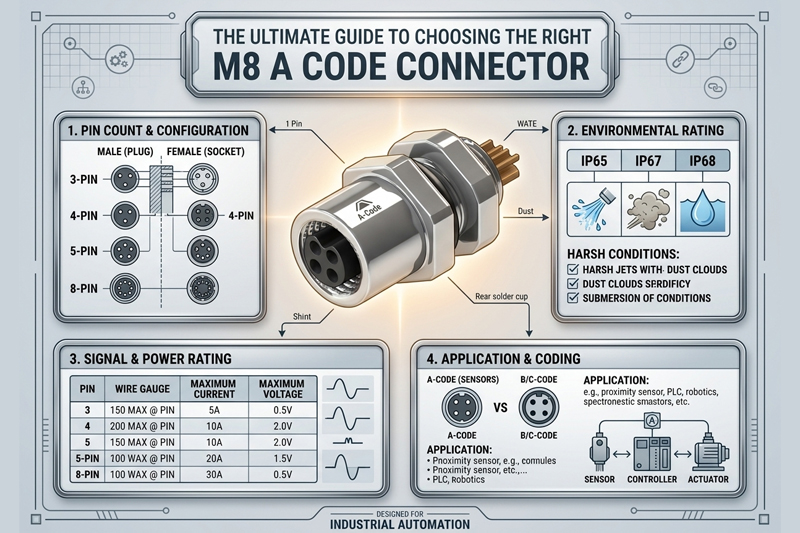
- Thread Size Explanation: The "M8" designation explicitly denotes the connector’s fastening mechanism—an 8mm metric thread. This threaded coupling ensures a secure, vibration-resistant physical mating, crucial for maintaining uninterrupted connectivity in active machinery.
- The IEC 61076-2-104 Standard: Professional-grade M8 connectors are strictly manufactured and tested in accordance with the IEC 61076-2-104 international standard. This guarantees global compatibility, consistent electrical performance, and uniform dimensional tolerances across different equipment manufacturers.
- The "A-Code" Meaning: In circular interconnects, "coding" refers to the internal mechanical keying profile designed to prevent accidental mismating with incompatible cables. The A-code is the universal, standard keying geometry specifically designated for low-voltage power distribution and standard signal routing.
- Typical Signal Transmission: M8 A-Code connectors are optimized for delivering stable DC power alongside direct digital or analog I/O signals, ensuring low-latency communication between field devices and central control units.
- Primary Sensor / Actuator Applications: Because of its reliable signal integrity and miniaturized footprint, the A-Code is universally recognized as the default interface for field-level sensor and actuator applications. It is the go-to solution for proximity switches, photoelectric sensors, and pneumatic actuators.
- Difference From M-Series Ethernet Connectors: It is critical to distinguish the A-Code from other coding profiles. While the A-Code is engineered for standard sensor signaling, other variations—such as the D-Code or X-Code—are explicitly designed for high-speed industrial data networks (e.g., Profinet, Industrial Ethernet). An A-Code connector cannot physically mate with, nor is it wired to support, these high-frequency Ethernet protocols. We recommend you to use M12 A code or M12 X code connector for Ethernet applications.
Top Industries and Applications for M8 circular Connector
The M8 A-Code connector is globally recognized as the industry standard for reliable signal and data transmission in compact spaces. Designed to withstand harsh environments, these rugged, waterproof connectors are the backbone of modern automated systems. Because of their space-saving footprint and high reliability, M8 A-Code connectors are widely adopted across various demanding applications:
- Industrial Automation: In smart factories, M8 connectors are essential for ensuring seamless communication between PLCs (Programmable Logic Controllers), control units, and heavy industrial machinery, minimizing downtime and maintenance costs.
- Sensors and Actuators: The "M8 A Code" is the default international standard for sensor connectivity. It is extensively used to connect proximity sensors, photoelectric switches, and actuators, providing stable power and signal routing even under continuous vibration.
- Robotics and Machine Vision: Space is a premium in automated guided vehicles (AGVs) and robotic arms. The compact size, combined with high resistance to shock and vibration, makes the M8 connector an ideal choice for internal wiring and industrial camera connections.
- IoT & Smart Manufacturing (Industry 4.0): As the Industrial Internet of Things (IIoT) expands, rugged M8 cables play a crucial role in connecting edge computing devices and remote environmental monitors that are exposed to moisture, dust, and temperature fluctuations.
Understanding your specific application and environmental challenges is the first step in selecting the perfect M8 connector combination for your project.
M8 A-Code Pin Out & Electrical Specifications
Choosing the correct pin configuration is critical for ensuring stable power delivery and accurate signal transmission in your devices. The M8 A Code connector offers flexible options ranging from 2 to 8 pins to meet various power and data requirements.
Below is a comprehensive reference guide detailing the front view pin assignments for both male (plug) and female (socket) M8 A-Code connectors, along with their standard current and voltage ratings.
| Code and Pins | Female Pin assignment Front view | Male Pin assignment Front view | Current Rated | Voltage (AC/DC) |
Typical Applications |
|---|---|---|---|---|---|
| M8 A code 2 pins |  |
 |
3A | 125V | M8 Connector 2 pin LED lighting, basic limit switches, and low-power devices. |
| M8 A code 3 pins |  |
 |
3A | 60V | M8 Connector 3 pin Standard proximity sensors, photoelectric sensors, and basic actuators. |
| M8 A code 4 pins |  |
 |
3A | 60V | M8 Connector 4 pin IO-Link devices, advanced sensors, safety switches, and standard automation I/O, Profinet. |
| M8 A code 5 pins |  |
 |
1.5A | 30V | M8 Connector 5 pin O-Link Class B devices, DeviceNet, CANbus, and complex fieldbus modules. |
| M8 A code 6 pins |  |
 |
1.5A | 30V | M8 Connector 6 pin Rotary encoders, measurement instruments, and advanced sensor hubs. |
| M8 A code 7 pins |  |
 |
1.5A | 30V | M8 Connector 7 pin Custom automation systems, proprietary machinery, and specialized medical/industrial equipment. |
| M8 A code 8 pins |  |
 |
1.5A | 30V | M8 Connector 8 pin Complex industrial encoders, machine vision systems, and multi-channel data acquisition. |
Explore Our Connetor M8 A Code Portfolio: Types & Mounting Options
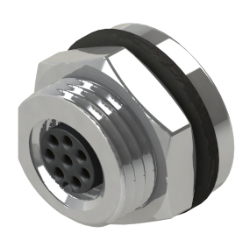
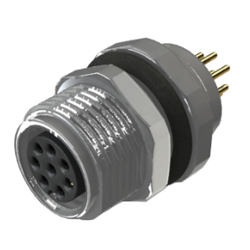
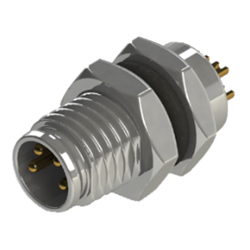
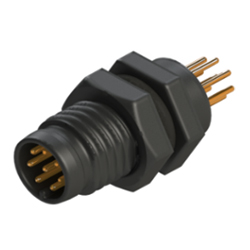
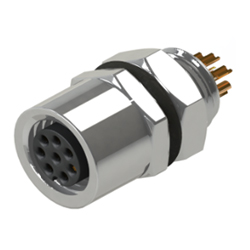
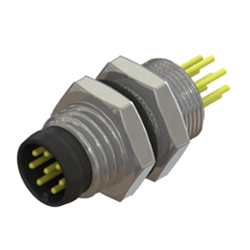
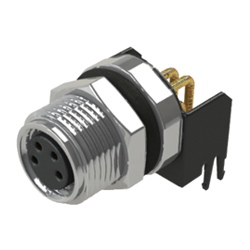
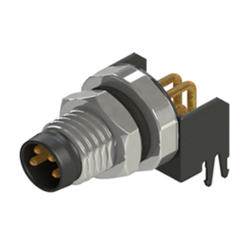
M8 A code Bulkhead connector (Panel Mounting, Chassis mounting connector)
Connector Housing: Brass with Nickel plating or Nylon + GF (plastic).
Pins: Brass with Gold plating 6u” thick.
Connector insert: Nylon + GF. UL94-V0
IP Protection: IP66, IP67, IP68 or IP69k.
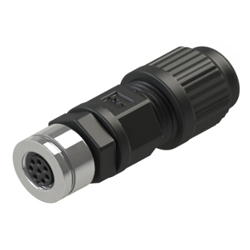
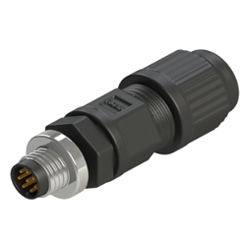
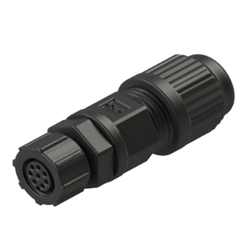
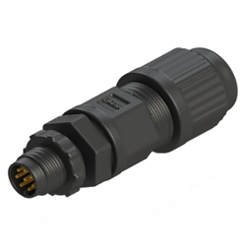
M8 cable connector (M8 field wireable connector)
- Connector overmold: PVC, TPU or custom.
- Screw nut: Brass with Nickel Plated or Nylon + GF (plastic).
- Pins: Brass with Gold plating 6u″ thick.
- Connector insert: Nylon + GF. UL94-V0.
- IP Protection: IP66, IP67, IP68 or custom.
- Cable: UL2464 or custom (Hydrolysis resistance, cold resistance, heat resistance, solvents resistance… cable can be customized.)
- Cable end assembly: Can be customized.
| Female Metal & Plastic nut |
Male Metal & Plastic nut |
|---|---|
 |
 |
 |
 |
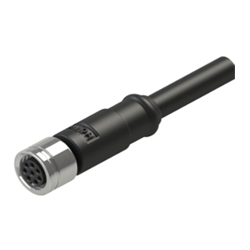
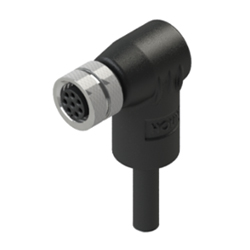
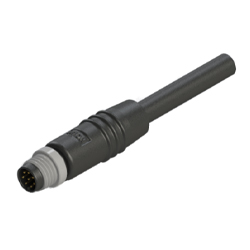
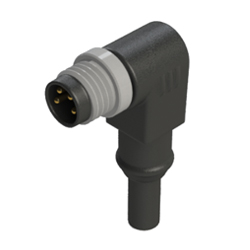
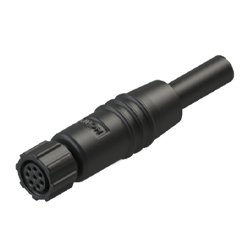
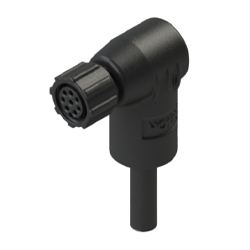
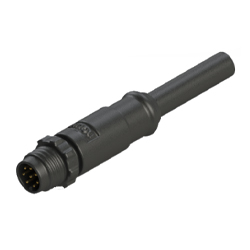
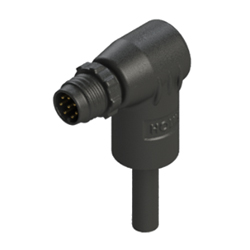
Cable M8 (M8 molded cable connector)
- Connector Housing: Nylon + GF (plastic).
- Screw nut: Brass with Nickel Plated or Nylon + GF (plastic).
- Pins: Brass with Gold plating 6u″ thick.
- Connector insert: Nylon + GF. UL94-V0.
- IP Protection: IP66, IP67.
| Female Metal & Plastic nut |
Male Metal & Plastic nut |
|---|---|
  |
  |
  |
  |
Regarding cable assembly, you can define any assembly like below
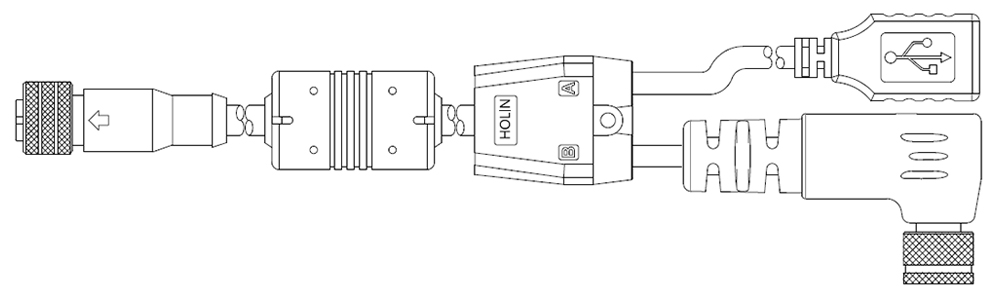
- M5, M8, M12, cable stripped or other connectors cable can be defined.
- Strain relief, component molding, splitter….can be defined.
Q&A
Expert Insights: Frequently Asked Questions About M8 Interconnect Solutions
Q1: What is the waterproof and environmental rating of a Holin-Tech m8 electrical connector?
A: Every Holin-Tech m8 electrical connector is engineered to survive the most punishing industrial environments. Our products are rigorously tested and certified to IP67 and IP68 waterproof and dustproof standards. This ensures absolute ingress protection for your critical systems, even during continuous submersion or exposure to high-pressure washdowns.
Q2: How does a Holin-Tech m8 cable assembly differ from standard market alternatives?
A: The difference lies in uncompromising material science and manufacturing origin. Unlike conventional options, every Holin-Tech m8 cable and connector features premium 6u″ gold-plated contacts for unparalleled conductivity and corrosion resistance. Furthermore, we exclusively use 100% premium virgin plastics—strictly zero recycled materials—guaranteeing structural integrity. All our products are proudly 100% Made in Taiwan, ensuring elite quality control.
Q3: For sensor applications, should I specify an m8 3 pin connector or an m8 connector 4 pin?
A: The choice depends strictly on your data and signaling architecture. An m8 3 pin connector is the universal standard for basic proximity and photoelectric sensors (Power V+, Power V-, and a single signal). However, if your architecture involves IO-Link devices, dual-channel safety switches, or requires a Normally Open/Normally Closed (NO/NC) setup, upgrading to an m8 connector 4 pin (or 4 pin m8) configuration is mandatory to support the additional data or signal routing.
Q4: Can I request custom modifications for an m8 circular connector, and what is your MOQ?
A: Yes. As a primary manufacturer, Holin-Tech specializes in bespoke interconnect solutions. Whether you need a non-standard wire length, specific jacket materials (such as PUR/PVC), or a customized pinout for an m8 circular connector, we accommodate specialized engineering requests. We also offer highly flexible and business-friendly Minimum Order Quantity (MOQ) policies to support both prototyping phases and mass production runs.
Q5: What is the typical lead time for a specialized m8 sensor cable?
A: We understand that supply chain velocity is critical for OEM and ODM clients. Because we maintain robust, vertically integrated manufacturing facilities in Taiwan, the lead time for a customized m8 sensor cable or standard m8 connector order is significantly optimized compared to industry averages. Exact timelines depend on the material specifications and volume, but we pride ourselves on rapid prototyping and highly reliable delivery schedules.
Q6: Decoding Ingress Protection: Selecting the Optimal IP Rating (IP65, IP66, IP67, IP68) for Your M8 Connector
To architect a fail-safe automation system, the Ingress Protection (IP) rating of your M8 connector must be precisely calibrated to the environmental realities of its deployment site. Under-specifying risks catastrophic short circuits, while over-specifying inflates project costs.
- IP65: Light Industrial & Indoor Automation
- Technical Definition: Complete protection against dust and defense against low-pressure water jets from any direction.
- Optimal Environments: Standard climate-controlled factory floors, basic packaging lines, and indoor material handling systems. IP65 M8 connectors are ideal where equipment is exposed to ambient industrial dust and occasional, light liquid splashing, but is never subjected to direct washdowns.
- IP66: Heavy Washdown & Outdoor Exposure
- Technical Definition: Complete dust protection and defense against powerful, high-pressure water jets.
- Optimal Environments: Maritime logistics, heavy machine tooling, and unprotected outdoor installations. If your sensors or actuators are exposed to heavy rainstorms, direct high-pressure cleaning, or significant machine coolant spraying, an IP66 rating is the minimum requirement to maintain signal integrity.
- IP67: The Harsh Environment Gold Standard
- Technical Definition: 100% dust-tight and protected against temporary immersion in water (up to 1 meter depth for 30 minutes).
- Optimal Environments: Food and beverage processing plants, pharmaceutical manufacturing, and heavy agricultural machinery. IP67 is universally mandated for environments demanding rigorous, daily hygienic washdowns with chemical foams and high-pressure hoses, or mobile equipment that may temporarily drive through deep puddles.
- IP68: Extreme Submersion & Mission-Critical Sealing
- Technical Definition: Hermetically sealed against continuous, prolonged submersion in water under specified hydrodynamic pressure.
- Optimal Environments: Wastewater management systems, deep-water level sensors, offshore marine platforms, and underground mining operations. When an M8 connector must operate flawlessly while permanently submerged in liquid, IP68 is the only acceptable engineering choice.
(Note: Holin-Tech specializes in manufacturing elite-tier IP67 and IP68 M8 A-Code connectors, utilizing premium overmolding techniques to ensure absolute environmental resilience in your most demanding applications.)
Q7: What dictates the choice between an M8 A-Code, B-Code, or D-Code connector? M8 A-Code vs B-Code vs D-Code
A: The coding of an M8 connector strictly defines its supported communication protocol and prevents catastrophic cross-mating in complex systems.
- A-Code (Sensors & DC Power): The universal standard for low-voltage power distribution and standard signal routing. Exclusively used for proximity switches, photoelectric sensors, and general factory I/O devices.
- B-Code (Fieldbus Networks): Engineered specifically for industrial network protocols, most notably Profibus and interbus systems, ensuring stable node-to-node data transmission.
- D-Code (Industrial Ethernet): Designed with an optimized impedance profile to support high-speed data transfer (up to 100 Mbit/s), making it the mandatory choice for Profinet and Industrial Ethernet connections.
Q8: How do I select the correct pin count (2 to 8 pins) for an M8 A-Code connector, and what is the standard function of each configuration? M8 A-Code Pinout & Wiring Diagram
A: Pin count selection is dictated by your system's power architecture and data density requirements. Over-specifying pin counts adds unnecessary cost, while under-specifying limits functionality. Below is the definitive reference matrix for M8 A-Code pin functionalities and their standard applications:
| Pin Count | Primary Electrical Function | Typical Industrial Applications |
|---|---|---|
| 2 Pins | DC Power Delivery (V+, V-) & Basic Switching | LED industrial lighting, basic limit switches, and low-power passive devices. |
| 3 Pins | Power (V+, V-) + 1 Signal Channel | Standard proximity sensors, photoelectric switches, and basic pneumatic actuators. |
| 4 Pins | Power + 2 Signals (NO/NC) or Data | IO-Link devices, safety interlocks, and standard automation I/O modules. |
| 5 Pins | Power + Multiple Signals / Auxiliary Power | IO-Link Class B devices, DeviceNet, CANbus, and sophisticated fieldbus modules. |
| 6 Pins | High-Density Signal & Data Routing | Rotary encoders, precision measurement instruments, and advanced sensor hubs. |
| 7 Pins | Specialized Multi-Channel Connectivity | Custom automation architectures, proprietary machinery, and specialized testing equipment. |
| 8 Pins | Complex Data Transfer & Multi-I/O | High-resolution industrial encoders, machine vision systems, and multi-channel data acquisition. |
For Example: Normal M8 A code 4 Pin connector’s pin define:
| Pin | Standard Wire Color | Function / Definition |
|---|---|---|
| 1 | Brown (BN) | Positive Supply Voltage (\(+24V\) DC) |
| 2 | White (WH) | Secondary Output |
| 3 | Blue (BU) | Ground / Common (\(0V\)) |
| 4 | Black (BK) | Primary I/O or IO-Link Signal |
You can define any pin define and wire color you like, HOLIN can custom them for you.
Q9. When should engineers specify a Right Angle overmolded connector versus a Straight M8 overmolded connector? How to Choose the Right M8 A-Code Connector
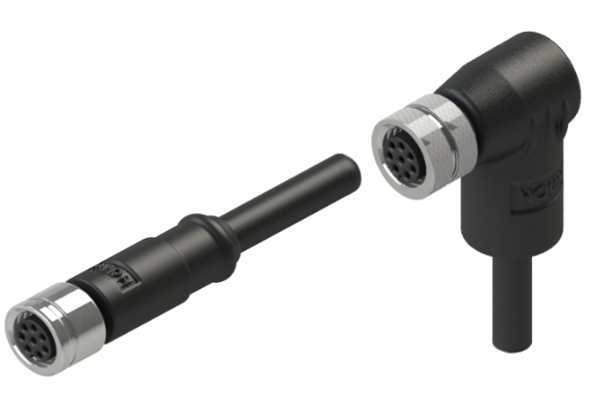
- Straight M8 Overmolded Connector: The default choice for linear cable routing where space is unrestricted. It offers the most straightforward installation for inline connections, panel outputs, and standard sensor arrays.
- Right Angle Overmolded Connector: Mandatory for applications with severe spatial limitations. It allows the cable to exit at a 90-degree angle flush against the equipment, preventing extreme cable bending that exceeds the minimum bend radius. This eliminates mechanical stress on the inner conductors and the connector joint, drastically extending the cable's lifecycle in compact machinery or AGV internals.
Q10. Under what conditions is a Shielded M8 connector mandatory over an Unshielded M8 connector?
A: This choice hinges entirely on the Electromagnetic Interference (EMI) and Radio Frequency Interference (RFI) profile of your operating environment.
- Unshielded M8 Connector: Suitable for standard, electrically "quiet" environments. They are cost-effective and offer greater cable flexibility, making them ideal for basic sensor routing where signal degradation from external noise is not a risk.
- Shielded M8 Connector: Absolutely critical in environments with high electrical noise. If your cable is routed near variable frequency drives (VFDs), heavy servo motors, welding equipment, or high-voltage power lines, a full 360-degree shielded connector is mandatory. The shield acts as a Faraday cage, preventing EMI/RFI from corrupting sensitive analog signals or high-speed digital data, ensuring zero data loss and system stability.